Water and energy for everyone · Volume two
21 Time, distance and shielding
12 – Time, distance and protection
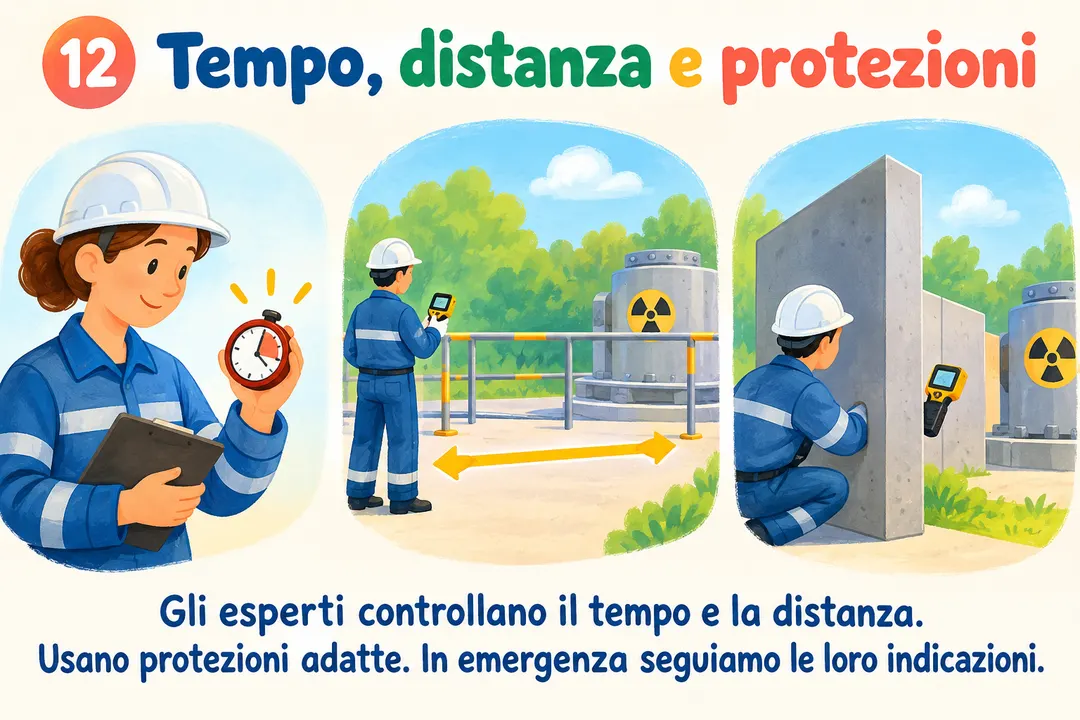
Experts check the time and distance. They use suitable protection. In an emergency, we follow their instructions.
Look, connect the ideas and tell the story
- Time
- Distance
- Shields
Words and symbols to help you tell the story. Sizes and distances are not realistic.
Experts limit the time spent near a source. When needed, they increase the distance. They also use suitable shields. A shield is a protection placed between the source and the person.
Which three ideas help reduce exposure?
21 Let’s discover together
Experts can reduce time spent near a source. They can increase the distance when this helps. They can place suitable materials between the source and people. These materials are called shields.
Not every shield is right for every kind of radiation. Not every situation is handled in the same way. People designing protections must understand the source and the work to be done. A protective suit can have a job, but it does not replace every protection in the power station.
- Time
- Distance
- Suitable shielding
A model to help us follow the idea. The colours and shapes are not measurements. Where arrows appear, they show the path described in the text.
21 Let’s draw and tell the story
Little helpers for my drawing
- Time
- Distance
- Shields
Look at these symbols. Then make your own drawing in the empty space.
Draw three separate scenes: a clock, a greater distance, and a shield chosen by an expert. The child explains which idea each picture recalls.
Add a question mark below the shield: ‘Which material is needed?’ This is a question for experts. Do not try to shield unknown objects with household materials. The paper makes three principles recognisable without turning them into operating instructions.

The story in my drawing
The adult can write down something the child says here.
21 For adults
Look, connect the ideas and tell the story
- Time
- Distance
- Shields
The symbols help you read the diagram. The text explains the choices and limits.
Time, distance and shielding
The choice of material depends on the radiation. Helmets and protective suits do not replace designed shielding. The drawings illustrate general principles; they do not give safe distances or times for a real situation.
Time, distance and shielding are principles to apply according to the source, geometry and type of exposure. Do not give universal distances or times that would be valid in every situation. Protection against contamination and shielding against external radiation have different functions.
The simple account must not suggest that wearing a suit is enough to approach any source. The work requires competent personnel and a risk assessment. Children are learning the names and roles, not designing a barrier. Link this chapter to measurement: a protection also needs to be checked, maintained and combined with the other defences.
The question and one possible answer
Which three ideas help reduce exposure?
Time, distance and suitable shielding are three principles to apply according to the situation.
Welcome gestures and unfinished answers too. Return to just one part of the picture if the connection is not yet clear.
Sources for further reading F4 F5 · Final section of the book
Explore with an adult · F4 International Atomic Energy Agency
https://www.iaea.org/publications/10885/safety-of-nuclear-power-plants-design

Explore with an adult · F5 World Health Organization
https://www.who.int/news-room/fact-sheets/detail/ionizing-radiation-and-health-effects
