Water and energy for everyone · Volume one
14 Two flows of water that stay separate
A6 – Heat makes steam
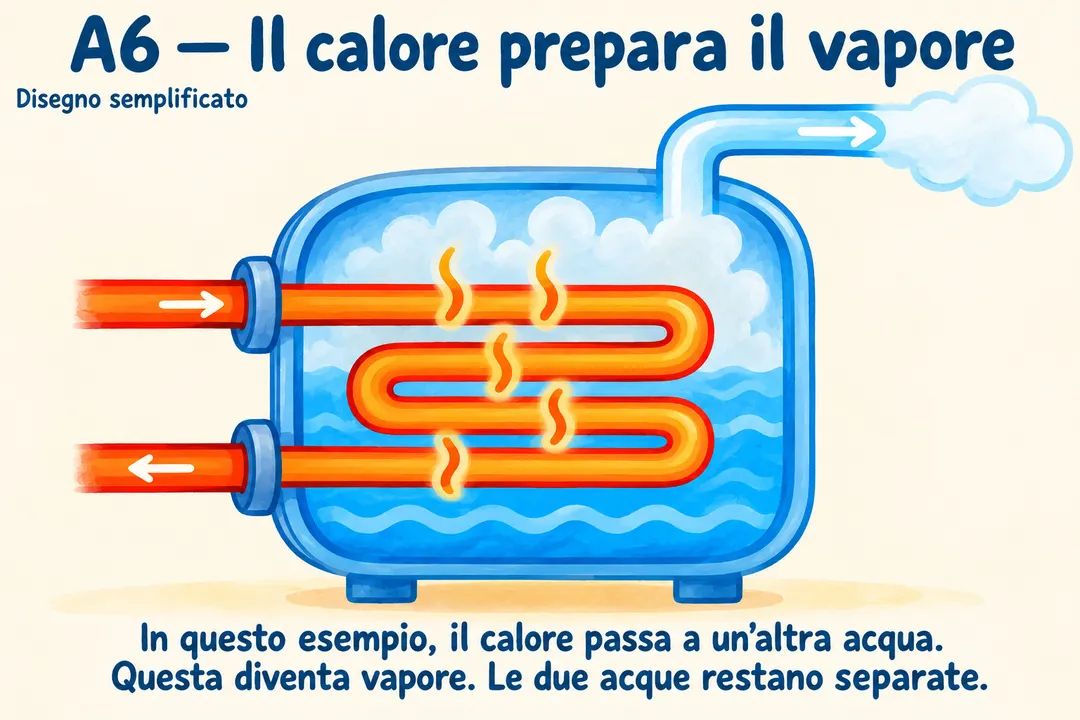
In this example, heat passes to a separate flow of water. That water becomes steam. The two flows stay separate.
Simplified drawing
Look at the orange pipe. Very hot water flows inside it. Outside the pipe is another flow of water. Heat passes through the metal and warms this second flow. The second flow turns into steam. The two flows of water do not mix.
What passes through the metal: heat or water?
Heat passes across. The water flows stay separate.
A simple model of heat exchange.
14 Let’s discover together
In our example, water follows two paths. One receives heat near the reactor. The other receives heat through a heat exchanger. When the system works as intended, the two flows do not mix.
The water on the second path can become steam and turn the turbine. Heat has passed through a suitable wall. The book shows a type of power station called a PWR. Other types have different paths. When we change the example, we must check which parts stay the same and which change.
- Primary circuit
- Heat exchange
- Secondary circuit
A model to help us follow the idea. The colours and shapes are not measurements. Where arrows appear, they show the path described in the text.
14 Let’s draw and tell the story
Little helpers for my drawing
- First flow of water
- Heat
- Second flow of water
Look at these symbols. Then make your own drawing in the empty space.
Draw two paths in different colours. Put the heat exchanger in the middle: two sides separated by a wall. The adult draws an arrow for the heat passing through the wall.
The child follows one path and then the other without joining the water lines. Ask, ‘What passes from one side to the other in our example?’ Heat. The drawing does not prove that faults cannot occur. It helps us understand how the system is intended to work.

The story in my drawing
The adult can write down something the child says here.
14 For adults
Two flows of water that stay separate
This is an example of a pressurised water reactor, or PWR. The primary circuit stays separate from the circuit that produces steam. In a boiling water reactor, or BWR, steam is produced inside the reactor vessel instead. The illustration therefore does not apply to every type of power station.
The separation shown applies to the PWR model. In a BWR, steam is produced in the reactor vessel and follows a different path. Do not extend this diagram to every nuclear plant.
The heat exchanger wall is a component that must be designed, verified and monitored. Its presence in a picture is neither proof of integrity nor an absolute guarantee. Connecting the plant to services for the public requires specific systems and assessments, including measures to prevent radionuclide transfer. To check understanding, ask the child to distinguish the heat arrow from the water lines. This distinction returns in the chapter about the integrated plant.
The question and one possible answer
What passes through the metal: heat or water?
In the PWR example’s heat exchanger, heat passes between circuits that remain separate during intended operation.
Welcome gestures and unfinished answers too. Return to just one part of the picture if the connection is not yet clear.
Sources for further reading F2 · Final section of the book
Explore with an adult · F2 U.S. Department of Energy
https://www.energy.gov/ne/articles/nuclear-101-how-does-nuclear-reactor-work
