Water and energy for everyone · Volume one
02 The blade shaped like two spoons
Two cups and an edge
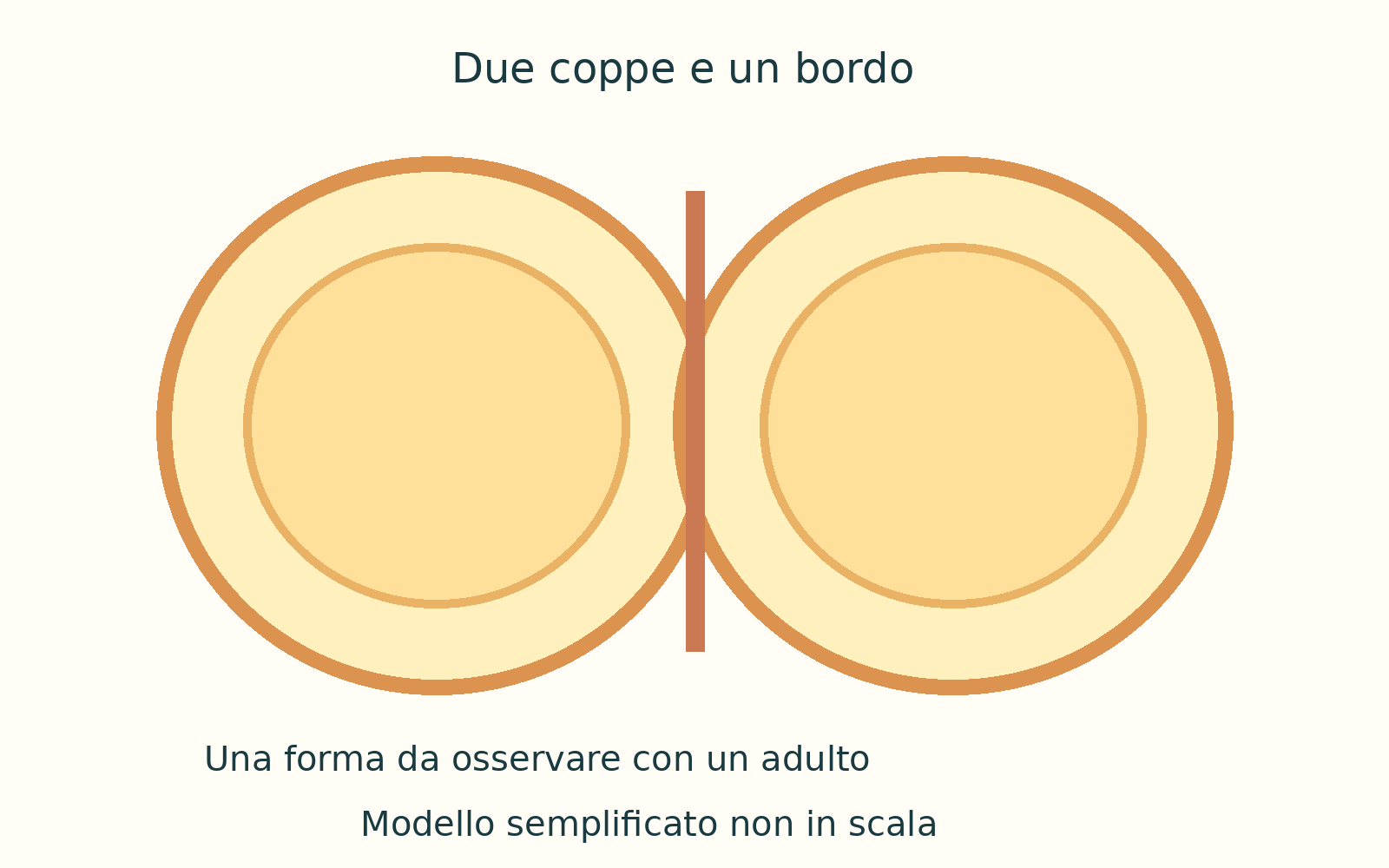
A shape to look at with an adult
Simplified model, not to scale
Look, connect the ideas and tell the story
- Water
- Blades
- Turbine
Words and symbols to help you tell the story. Sizes and distances are not realistic.
Some turbines have blades that look like two spoons joined together. A jet of water hits the middle. It splits and follows the two curved sides. As the water changes direction, it pushes the blade. Many blades make the wheel turn.
Why is the blade curved?
02 Let’s discover together
Look at two large spoons drawn side by side. They help us picture the blade, although a real blade is specially made. The jet hits the middle. The water follows the curves and changes direction. This push helps to turn the wheel.
‘Why don’t we make every blade the same?’ Because water does not always arrive in the same way. Experts choose the type of turbine after studying the place. Pelton is the name of one of these families of turbines.
- A jet of water
- Two curved cups
- A push on the blade
A model to help us follow the idea. The colours and shapes are not measurements. Where arrows appear, they show the path described in the text.
02 Let’s draw and tell the story
Little helpers for my drawing
- Water
- Blades
- Turbine
Look at these symbols. Then make your own drawing in the empty space.
On paper, the adult draws a blade with two joined cups and an edge in the middle. The child draws a blue line towards the edge, then continues the path along both sides.
Look at a view from above and a side view prepared by the adult. ‘Are we looking at two different objects?’ No. It is the same model seen from different positions. Drawings help us understand shapes. By themselves, they do not show that a real machine will work.

The story in my drawing
The adult can write down something the child says here.
02 For adults
The blade shaped like two spoons
This is the principle of the Pelton turbine. The central edge divides the jet between the two cups. The water’s change of direction produces a force on the blade. A view from above and a cross-section show different aspects of the same interaction. The wooden wheel in the previous scene is not a Pelton turbine.
The two-spoon comparison helps the child recognise the double cup without needing to know fluid dynamics. The edge splits the jet, and the curved surfaces redirect its flow. Do not present the wooden wheel from the previous chapter as a Pelton turbine.
A cross-section is an imaginary cut that lets us see an internal shape. A view from above is a different perspective. Development requires dimensioned drawings and relevant tests. This activity is only about reading shapes; it is not an efficiency test. Ask the child to point to the edge that divides the jet, accepting a gesture as an answer too.
The question and one possible answer
Why is the blade curved?
The curves change the water’s direction and allow it to push the blade.
Welcome gestures and unfinished answers too. Return to just one part of the picture if the connection is not yet clear.
Sources for further reading F1 · Final section of the book
Explore with an adult · F1 U.S. Department of Energy
https://www.energy.gov/cmei/water/types-hydropower-turbines
